Understanding how animals learn is key to influencing and interpreting their behavior. People tend to think of learning as something that happens when they deliberately train animals (e.g. in teaching dogs to sit or come), but learning happens all the time. Everything that a dog or cat experiences throughout its life will impact subsequent behavior to some extent. Learn how your feline learns so that you can better train it.
Associative Learning
There are two forms of associative learning: classical conditioning and operant conditioning.
Discovered by Nobel prize-winning Russian physiologist Ivan Pavlov, classical conditioning is a learning process that occurs through associations between an environmental stimulus and a naturally occurring stimulus. Also known as Pavlovian or respondent conditioning, the learning procedure pairs a biologically potent stimulus (food) with a previously neutral stimulus (a bell).
Burrhus Frederic (B.F.) Skinner is regarded as the father of operant conditioning. His work was rooted in the view that classical conditioning was far too simplistic to be a complete explanation of complex behavior. He believed that the best way to understand behavior is to look at the causes of an action and its consequences.
Operant behavior meets two conditions: It is freely done by an animal, in the sense that there is no obvious triggering stimulus; and it is susceptible to reinforcement and punishment by its consequences, as much as it can be caused to go up or down in frequency.
How Classical Conditioning Works
Classical conditioning involves placing a neutral signal before a naturally occurring reflex. In Pavlov's classic experiment with dogs, the neutral signal was the sound of a tone and the naturally occurring reflex was salivating in response to food. By associating the neutral stimulus with the environmental stimulus (presentation of food), the sound of the tone alone could produce the salivation response.
Dogs don’t normally go around salivating when they hear bells; the response happened because the dogs learned that the bell was a reliable indicator of the imminent arrival of food. This type of learning is a huge evolutionary advantage: Identifying events that indicate the approach of a predator gives an animal time to get away. Equally, reacting to early indicators of food means getting to the resource first.
Another famous example of classical conditioning is John B. Watson's experiment in which a fear response was conditioned in a boy known as Little Albert. The child initially showed no fear of a white rat, but after the rat was paired repeatedly with loud, scary sounds, the child would cry when the rat was present. The child's fear also applied to other fuzzy white objects resembling the rat.
Classical conditioning had a major influence on the school of thought in psychology known as behaviorism. Behaviorism is based on the assumption that:
- All learning occurs through interactions with the environment.
- The environment shapes behavior.
- Taking internal mental states such as thoughts, feelings, and emotions into consideration is useless in explaining behavior.
Cats and Classical Conditioning
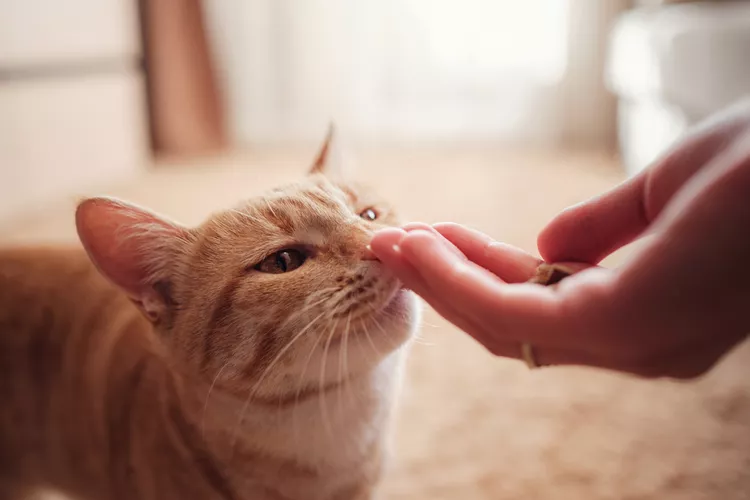
Cats learn in a variety of ways and cat training has a basis in several techniques. Classical conditioning is a technique used to teach cats to learn or to become conditioned to a particular sound, smell, or behavior associated with the desired response. For example, the whir of the can opener (associated with food) triggers the cat to come running to the food bowl. Or the sound of a clicker during clicker training becomes associated with a food reward and can be used to communicate what you want the cat to do.