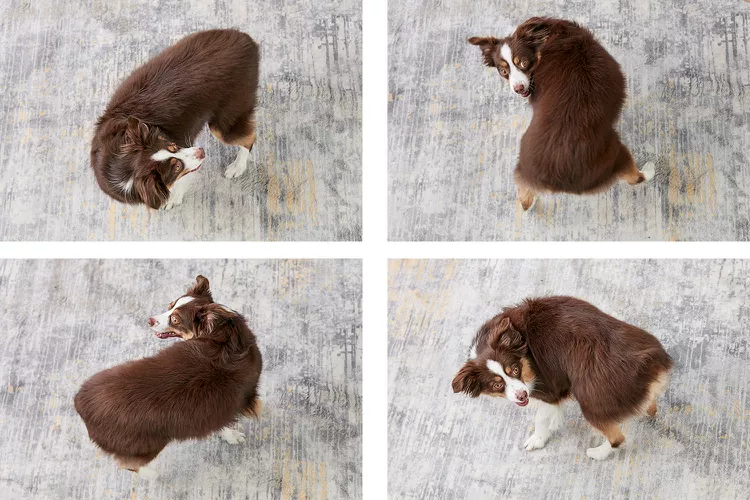
Teach your dog, old or young, a new trick of doing a twirl on command. You can train a dog to simply spin in one direction, or you can train your pup to discriminate between left and right. Either way, all you need to train a dog to spin is a handful of treats. If you are clicker training, you should also have a clicker on hand.
Teach a Basic Spin
To teach your dog to spin, you'll want to start with your dog in a standing position. If your dog doesn't know how to stand on command, it will be easier to learn that first, and then work on spinning. With a few treats in your hand, you're ready to get started.
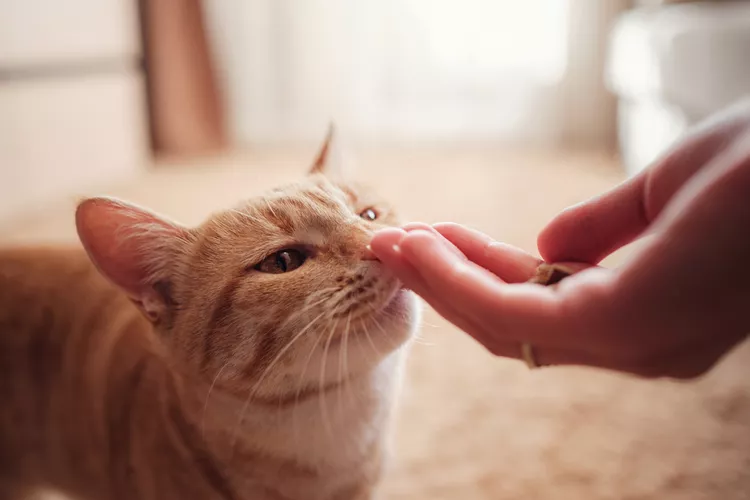
- Hold a treat in front of your dog's nose. Slowly pull the treat toward the side of your dog's head, so it has to turn its head to follow the treat.
- Keep pulling the treat in a circle all the way around your dog's body, so it will have to spin in order to keep track of the treat.
- Once your dog has followed the treat in a complete circle, tell the pup "yes" or "good," or click your clicker. Then quickly give your dog the treat.
- Repeat steps 2 and 3 several times.
- Once your dog seems to understand the action, add the command word "spin" before once again repeating steps 2 and 3.
- Spend about five minutes, several times a day, practicing the spin. Your dog will be spinning in a complete circle before you know it.
Add Direction
Once the dog twirls on command, you can begin training your canine to learn directions.
- Begin as you did above with a treat in front of your dog's nose.
- This time, change the command to "right spin" or "left spin." Give the command, and pull the treat around your dog in the direction you want it to spin.
- Practice in several short training sessions each day. Be sure to work on only one new command (right or left spin) at a time until your dog has a solid understanding of the difference between the two commands.
- Once your dog knows how to spin both right and left on command, you can begin to change it up. Ask it to spin in different directions during one training session. Once your dog is able to consistently respond correctly to the command by spinning in the correct direction, you'll know it has a good grasp of the difference between the two commands.
Problems and Proofing Behavior
While some dogs will learn to spin in just a few training sessions, others might get stuck or find it hard to complete a spin. Some may have trouble learning to spin in a complete circle the first time. In this case, you can start out smaller and work up to spinning all the way around. This technique is called shaping, and it works exceptionally well with the clicker.
If you need to shape the spinning behavior, start off by pulling a treat to one side of your dog's head. As soon as it turns its head, click or tell the dog "good" and give a treat. Once it is consistently turning its head, you can begin only clicking and treating when the dog turns its head and takes a step toward turning around. In this way, you can slowly select the behaviors that bring your dog closest to turning around completely until the pup is able to turn in a complete circle with only one treat at the end.
If it seems as if your dog knows the command, but then begins to make mistakes, chances are you've moved ahead too quickly. In this case, simply go back a few steps to where your dog was completely successful. Practice that step over a few sessions, and then begin moving ahead again slowly.
Dogs, like humans, can get dizzy. A common mistake is to train for too long and can result in a dizzy and confused dog. Only practice for limited times, and if your dog really seems to dislike the training or the spinning sensation, there is no need to continue it. A twirl dog command has no real use and is only a fun trick, so if your dog can't do it, focus on other things your dog does well.