Ragamuffin: Cat Breed Profile
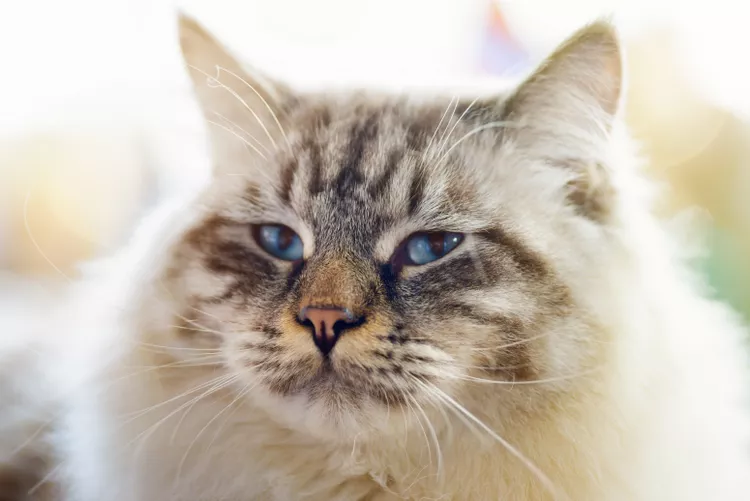
Best known for their large, long bodies and super plush coats, Ragamuffin cats are true lap cats that love to be cuddled by their owners. Often referred to as "puppy-like," Ragamuffin cats are intelligent, friendly and super personable. Plus, many Ragamuffins learn to love new tricks and play games, like fetch. Some even learn to love walking on a leash!
Ragamuffin cats are also highly adaptable, meaning they can thrive in a variety of home types—from apartments, to larger single-family households—and they make excellent companions for a family with younger kids or other pets.
It's true that Ragamuffins are extremely calm, docile cats, but their personable natures mean they can become bored without enough attention and entertainment. If you bring a Ragamuffin cat into your home, you can expect to dedicate several hours per day to play- and cuddle-time.
Breed Overview
Weight: Males typically weigh between 12 and 20 pounds, while females weight between 8 and 15 pounds.
Length: Up to 33 inches long
Coat: Long and silky
Coat Color: White, black, blue, red, lavender, cinnamon, chestnut, platinum, and chocolate
Eye Color: Amber, blue, green, gold, odd-eyed
Life Expectancy: Up to 18 years
Characteristics of the Ragamuffin
History of the Ragamuffin
Like its close cousin, the Ragdoll, Ragamuffin cats have a fairly short history as a distinct breed. After the Ragdoll was first produced by Ann Baker in the 1960s, a group of breeders wanted to boost the variety in their cats' coat colors and patterns and body sizes. Plus, they wanted to add more genetic variation to their litters—a wider gene pool can offer some protection against hereditary or genetic health conditions. Ann Baker strictly controlled the breeding of Ragdolls—and didn't want to add variation to her breed—so these breeders set out to create their own distinctive breed.
These breeders crossed Ragdoll cats with Persians, Himalayans and domestic, long-haired cats to increase the size of their cats, and to create physical attributes that would differentiate Ragamuffins from Ragdolls. Although the name "Ragamuffin" was initially a joke made by one of the original breeders, it stuck when the official breed registry couldn't be changed. Plus, it's an homage to Ragdoll cats, which first inspired them.
Today, Ragamuffins are an official breed recognized by the United Feline Association, the American Cat Fanciers Association, and the Cat Fanciers Federation. It wasn't until 2011 that Ragamuffins were officially recognized by the Cat Fanciers Association.
Ragamuffin Care
Unlike many cats with long, silky coats, Ragamuffins' coats are relatively low-maintenance. Because they're tangle-resistant, you can expect to brush or comb your Ragamuffin once or twice per week to remove any minor tangles or mats, and remove dead hair build-up. What's more, Ragamuffins aren't prone to excessive shedding.
Be sure to check your Ragamuffin's ears every week, and gently remove any dirt or debris with a dampened cloth or cotton ball. If your Ragamuffin's ears are excessively dirty, red, inflamed, or smell bad, make an appointment with your vet immediately. Avoid using cotton swabs, as they can damage the delicate inner-ear structures.
If your Ragamuffin has any discharge around the eyes, remove it with a soft, dampened cloth. Use different parts of the cloth for each eye to avoid potentially spreading infection.
Like any breed of cats, Ragamuffins can develop periodontal disease without proper dental hygiene. If you're not able to brush your cat's teeth daily, aim for at least once per week. Tartar control treats can be given in moderation, but shouldn't be the only method of dental hygiene for your cat.
As previously mentioned, Ragamuffins are extremely playful and love attention from their owners, but can become bored if not properly stimulated. It's important to dedicate time each day to playing with your Ragamuffin. You can keep him or her engaged and entertained with lots of cat toys, games, and even fetch. Because Ragamuffins have such playful personalities, something as simple as a ball can keep her entertained for hours.
Because Ragamuffins also have a fearless personality, it's vital to never let him or her outside.
Common Health Problems
Although genetic variation offers some protection against inherited health problems, Ragamuffins can be susceptible to certain conditions. Not every Ragamuffin will develop these conditions, but it's important to know the signs should they arise in your cat.
Some health issues that are common in Ragamuffins include:
- Polycystic kidney disease (PKD): PKD is the development of multiple cysts on a cat's kidneys. It's not immediately life-threatening, but should be treated as early as possible in order to prevent the development of new cysts and to reduce the risk of dangerous bacterial infections.
- Hypertrophic cardiomyopathy (HCM): This type of heart disease is extremely common in cats, and is characterized by the thickening of the heart muscle. Cats with HCM are typically removed from breeding lines, but there's no guarantee against it.
If you're concerned about these and other health conditions in your Ragamuffin, talk to your veterinarian. They'll be able to offer advice on keeping your cat as healthy as possible, so he or she can live a long, happy life.
Diet and Nutrition
Like any cat, it's important to avoid overfeeding your Ragamuffin; they're large cats, but they should not be fat. Your Ragamuffin's dietary needs will depend on his or her age, sex, and activity levels, but generally, he or she should eat a serving of high-quality cat food each day. If you want to add some variation to the diet, you can mix some wet food into meals a few times per week.
If you have questions about how much to feed your Ragamuffin, or feel that he or she is gaining too much weight, talk to your vet about the right diet for your pet.
More Cat Breeds and Further Research
Before bringing any pet into your home, it's important to do your research and make sure your family and schedule can accommodate daily pet care. Ragamuffin cats are fairly low-maintenance, but they do require playtime and attention daily.
If you're interested in breeds similar to the Ragamuffin, check out:
- The Maine Coon
- The Ragdoll
- The Persian