
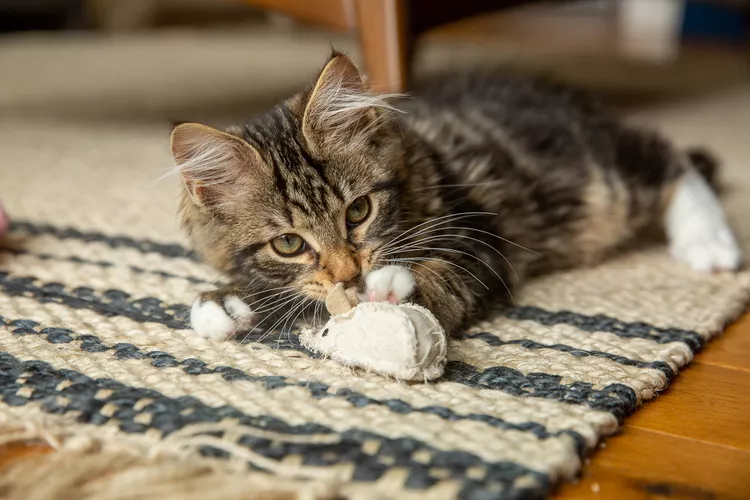
Kittens can be aggressive out of fear or playfulness, though both behaviors may look identical. You may feel as though your kitten is trying to attack you, jumping out at you from behind the couch, scratching at your hands, or randomly biting your shoes. It's unlikely that a scratch or bite from a house cat will be fatal, but such injuries can be painful and run the risk of infection. There are ways to address a kitten's aggressive behavior, most of which require just a little extra attention from its owner. Here's what you should know if your kitten is showing aggressive behavior.
Why Are Kittens Aggressive?
The stalking and hunting instincts of their ancestors are still very strong in modern-day house cats. Usually, a cat sees something moving in a way that provokes the instinct to attack, meaning that the cat considers the object (a hand, a foot, a small child) to be a threat or prey. Either way, the cat is driven to use its claws and possibly its teeth to complete the attack.
- In kittens, most aggression is caused by fear or curiosity. In older cats, there may be other reasons for cat aggression and attacks, such as redirected aggression, or when a cat lashes out at its owner because it senses something is wrong.
- A kitten that's protecting its "territory" from a perceived threat or interloper (such as a small child or another animal) also may become aggressive. While this behavior may be normal at first, if it doesn't subside within a few months, it may be time to take corrective action.
- Of course, aggressive behavior may come from a mother cat protecting her kittens. An animal in pain or one that feels threatened may also lash out. But if it attacks under these circumstances, it's easily attributed to a specific cause, which is different from sustained or frequent aggressive behavior.
Signs of Aggression
Both play aggression and predatory aggression include distinct body language:
- Any combination of stealth, silence, alert stance, hunting postures, and lunging or springing at "prey" that moves suddenly after being still.
- Twitching, meowing, and tail swatting.
- Bluffing behavior, such as when a cat arches its back, that doesn't usually lead to an outburst but is instead one cat's way of showing another cat that it's not to be messed with.
Aggression Triggers
Most cats that are paired together at an early age learn to coexist peacefully, with the occasional disagreement. It's the cat owners who are the most frequent targets of kittens' aggression, especially those who don't live with other cats.
- Nearly any type of movement, from walking to picking up an object, triggers the behavior.
- What begins as "play" can tip over into dangerous aggression, bites, and outright attacks when the kitten or cat becomes aroused. The hands and feet of pet owners are the most frequent targets.
- Hand-raised kittens and those weaned early are more likely to engage in this type of behavior. They are known to terrorize shy, fearful cats, bully smaller kittens, and pester geriatric felines, in addition to targeting owners.
- While less dangerous in kittens, older cats that act like predators toward small children or smaller pets can cause serious injury, which is why it's important to train kittens out of this kind of behavior well before it becomes problematic.
How to Stop Aggression
Before trying behavior modification techniques, it's worth a trip to the veterinarian to make sure there isn't an underlying medical condition causing a kitten's aggression. Diseases such as hyperthyroidism, osteoarthritis, dental disease, and central nervous system problems can make your otherwise docile and friendly cat become aggressive with little warning. A checkup to ensure your kitty's overall health should be your first step.
If your kitten gets a clean bill of health, the next step is to curb its behavior. This can take some time because cats are not social animals like dogs and don't respond the same way to aversion therapy. Prepare to be patient.
There are a number of ways you can encourage healthy, vigorous play in your kitten but avoid aggressive behavior that may result in injury.
- Place a bell on the attack cat to give other cats or small children in the household time to escape and to cue you so you can interrupt and stop the behavior.
- Stop an attack in progress via a water gun, citronella spray, or the sound of hissing air from an aerosol can. Experiment to find out which one works best.
- Put a harness and leash on the cat to give you better control and the ability to interrupt undesirable behavior. Simply stepping on the end of the leash can stop a pet in its tracks.
- Play interactive games with your kitty to burn off energy. One tip is to move toys up and down across its field of vision, rather than toward or away from it, to spark the greatest interest. Interactive play also encourages confidence in shy cats so they can learn manners.
- Create a regular routine that includes a specific time for play, so that playtime becomes a part of your cat's daily expectations.
- Spay or neuter kittens before their first birthday. This greatly reduces cat-on-cat aggression, particularly if the animals housed together are of different sexes. Sometimes even neutered male cats bicker with each other.
- A second kitten of the same age, size, and temperament can often provide a target and playmate and help teach a feisty kitten some bite and claw inhibition. Be sure to properly introduce the pair.