
Postnatal care of a mother cat and her newborn kittens is crucial after she has given birth, and your observational skills are essential during this delicate time. In the first few weeks, look for warning signs of health issues and kitten developmental milestones like their physical activity.
Postpartum may occur in the mother cat, so make sure she and her kittens are in a comfortable, warm space that is separated from busier parts of the house. Thoroughly checking for any abnormalities in behaviors or physical appearances will also help you indicate issues quickly, so you can get veterinarian help as necessary. Here's everything you need to know about what to do after your cat gives birth.
Veterinarian Check
If you haven't already done so, after one week, take the mother cat and kittens to your veterinarian for a wellness check. If the mother cat was not vaccinated, this would be a good time to do it. Also, she might get treatment for roundworms to protect both her and her kittens.
New Kitten and Mother Cat Care
The first two to three weeks are the most crucial for a mother cat and her newborn kittens. The kittens should be developing rapidly, and if the mother is going to have any postpartum problems, it will happen during that period.
Let the mother cat set the pace for your attention. If she has been your pet for a while, she may welcome your visits. A rescued stray or fostered cat may prefer that you stay away. As long as the kittens are nursing frequently and appear to be thriving, they will be OK.
Keep the mother cat and her babies in a quiet part of the house; a separate room is ideal. Make sure the room is warm enough as kittens are unable to regulate their body temperature when they are only a few days old. The mother cat can keep the babies warm, but if she leaves to eat or use a litter box, the kittens can get cold. Chilling is one of the most critical dangers to newborn kittens. Provide blankets, a heat lamp, or a heating pad to ensure the kittens stay warm.
Use a large enough box to comfortably hold the mother cat and her kittens. Stack clean towels to line it. The towels will become soiled quickly as the kittens defecate. It will be easiest to remove the top towel to reveal a clean layer.
Keep the mother cat's litter box, food, and water bowls close by. Make sure you are feeding her a high-quality canned kitten food, supplemented with KMR (kitten milk replacement). These specially formulated foods ensure that a nursing, postpartum mother cat gets the nutrients she needs.
Kitten Developmental Milestones
Three days after birth, a kitten's eyes start opening, and the umbilical cord will also fall off. Their nervous systems are not fully developed; you may notice them twitching during sleep. This twitching is entirely normal and indicates the development of their nervous system and muscles.
By two weeks, the kittens will start crawling around and will be attempting to stand. Their teeth will be starting to come in during this time. If you put your finger in their mouth, you will be able to feel tiny teeth nubs.
For the first three weeks, the mother cat will lick each kitten around the abdomen and anal area after nursing to encourage the elimination of waste. In her absence, you will need to simulate this task with a warm, damp washcloth.
By three weeks, the kittens should be walking around and actively playing. You can introduce them to wet food and supplement it with KMR. They should still be actively nursing. You can also introduce them to the litter box. At this age, avoid clumping clay litter. The best litter for young kittens is any premium non-clay litter or the World's Best Cat Litter.
Health Issues in Newborn Kittens
Intestinal parasites are most common in kittens. Other health problems in young kittens are infectious diseases, such as respiratory infections, and congenital diseases.
Fading kitten syndrome occurs when a kitten fails to thrive. If you notice one of the kittens is generally more lethargic and sleeping a lot more than its siblings, it can be a sign of the syndrome. That kitten requires immediate attention from a veterinarian who specializes in kitten care.
Postpartum Health Issues
Pregnancy, birth, and the period after delivery are a stressful time for the body of a new mother. A new mother has a flood of hormones, milk production begins, and recovery from the birth process is in full swing. There are a few severe conditions to keep an eye out for in your mother cat.
Mastitis
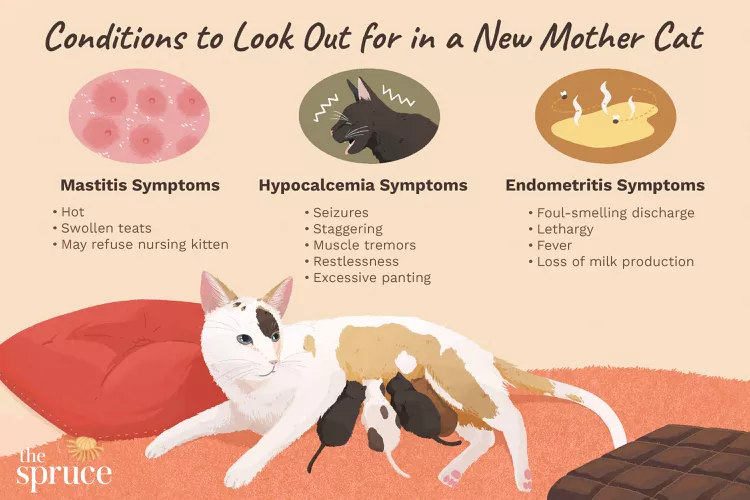
Mastitis is a bacterial infection of the milk ducts, which occurs when the mother cat's milk production gets blocked by inflamed mammary glands. The teats become swollen and hot, with apparent "bruising," and the mother cat may refuse to allow the kittens to nurse. Mastitis is a veterinary emergency. The cat usually needs antibiotics to fight the infection. The kittens may need to be hand-fed until the mother cat has recovered.
Hypocalcemia
Hypocalcemia, also known as "milk fever," is rare in cats, but it is another veterinary emergency. This condition can result from a lack of calcium during pregnancy and nursing. Symptoms include seizures, staggering, muscle tremors, restlessness, and excessive panting. While the mother recovers, the kittens will need to be fed by hand.
Uterine Metritis
Metritis is a severe infection of the uterus; it is also a veterinary emergency. The mother cat will usually have normal vaginal drainage after birthing her kittens. But, if you notice a foul-smelling discharge, that is a red flag. Other symptoms include lethargy, fever, and loss of milk production.
The mother cat may have to be hospitalized for treatment and might need an emergency spaying. As the mother cat recovers, feeding and care for the kittens will fall to you.